
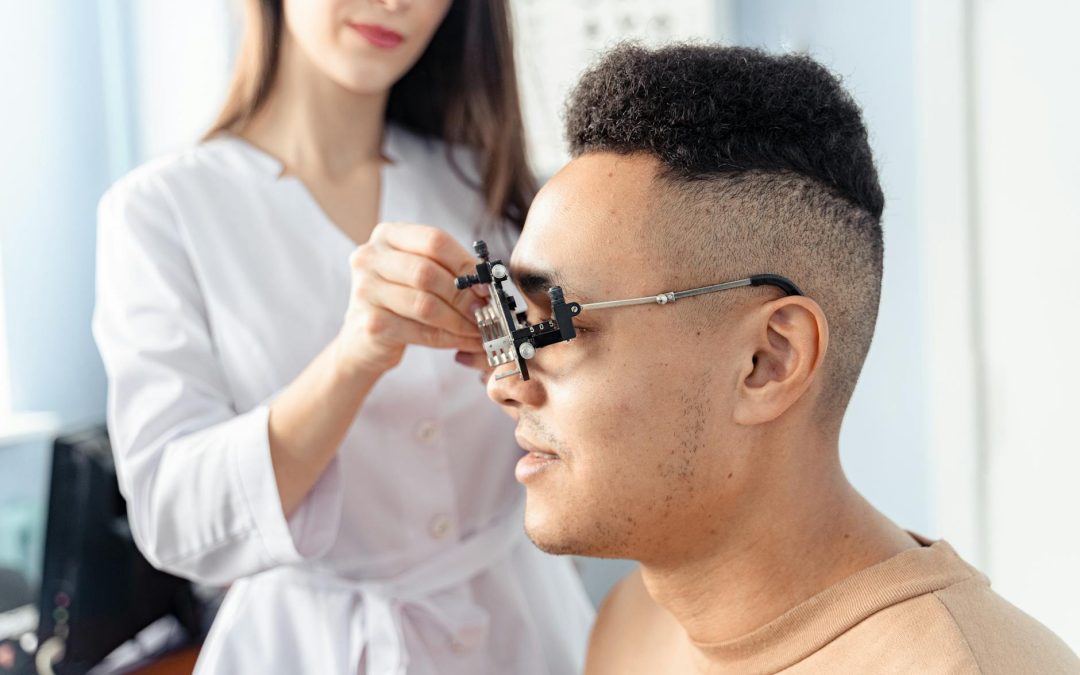
The short version. A modern comprehensive eye exam is not just “read the chart and get a prescription.” A proper exam in 2026 includes refraction, ocular health screening, corneal topography (we use a Scheimpflug Tomographer, TMS-5), tear-film assessment, intraocular-pressure check, and a discussion of your specific concerns. At Vision Experts the standard adult exam runs 45–60 minutes and the paediatric exam runs 60–90 minutes including cycloplegia. The point is not to sell glasses — it is to catch the things that hurt your vision long-term (keratoconus in young adults, glaucoma in older adults, diabetic retinopathy at any age, dry eye disease in everyone) early enough to do something about them.
What a “comprehensive” eye exam actually contains
The phrase gets used loosely. Some optical shops offer a “free eye exam” which is just an autorefractor reading and a chart check — fine for ordering glasses but missing most of the medical content of a real exam. A comprehensive exam should cover all of the following:
- Case history. Why are you here, what symptoms, what medications, family history of eye disease, occupation, vision habits. Five minutes of conversation determines what the rest of the exam should look at.
- Distance and near visual acuity with and without correction. Standardized charts at standardized distances. We use both letter and tumbling-E charts for paediatric and non-literate adult patients.
- Autorefraction and keratometry (NIDEK ARK-1). The starting point for refraction. Quick, objective, machine-derived.
- Subjective refraction. The “better one or two” exercise. This is where the prescription is actually nailed. It takes 10–15 minutes done properly.
- Binocular vision assessment. How the two eyes work together. Important for headaches, eye-strain symptoms, reading difficulty in children.
- Slit-lamp biomicroscopy. Live magnified view of the front of the eye — eyelids, conjunctiva, cornea, iris, lens. This is where most pathology is found.
- Tonometry. Intraocular pressure measurement. A glaucoma screen.
- Dilated fundus exam (when indicated). Drops to widen the pupil so we can look at the retina, optic nerve, and macula. Required for diabetic patients, anyone over 50, anyone with a family history of retinal disease, and anyone with new floaters or flashes.
- Corneal topography (TMS-5 Scheimpflug Tomographer). Anterior and posterior corneal elevation maps. Essential for keratoconus screening in teens and young adults, for contact lens fitting, and for any refractive surgery candidate.
- Tear film assessment. Tear break-up time, meibomian gland evaluation. Most adults over 30 have some dry-eye component and most don’t realize it.
What we look for, by age
Children (5–14)
The focus is detecting and quantifying refractive error, ruling out amblyopia (“lazy eye”), assessing binocular function, and — critically — screening for myopia onset and rate of progression. The exam uses age-appropriate testing (picture charts for under-7s, tumbling E for non-literate, letters for older). Cycloplegic refraction (drops that paralyze the eye’s focusing muscle) is routine for children under about 15 — without it, the autorefractor systematically over-estimates myopia and under-estimates hyperopia in this age group.
For myopic children we also measure axial length and discuss myopia-control options at the first visit. Stellest, MiYOSMART, MyoCare and Ortho-K are all evidence-based interventions; choosing among them depends on the child and the family.
Young adults (15–35)
The big-ticket item is keratoconus screening. This age range has the highest incidence of new keratoconus diagnoses, and the Middle East has higher prevalence than the global average. A standard refraction does not catch early keratoconus — corneal topography does. We image every young-adult patient who comes in for a “routine” exam, especially those with rapidly changing prescriptions, frequent eye-rubbing, or family history.
This age range is also when contact lens fitting and modern eyewear become major decisions. We talk through frame and lens options based on lifestyle, not based on what is in stock.
Adults (35–55)
Presbyopia begins to surface in the early-40s. Multifocal options (progressive lenses, multifocal contacts, monovision) are discussed. Dry-eye screening becomes more relevant — modern environments (screens, air conditioning, contact lens wear) drive evaporative dry eye in a large fraction of adults, often without obvious symptoms beyond intermittent blurring.
Tonometry becomes important at the upper end of this range — glaucoma is asymptomatic until late, and an annual pressure check is the simplest screen.
Adults (55+)
Age-related macular degeneration, cataract, primary open-angle glaucoma, and diabetic retinopathy all become statistically more important. Dilated fundus exam annually is the default. Cataract is discussed when visual symptoms appear; surgical referral is a co-management with our ophthalmologist colleagues.
For older patients we also pay closer attention to systemic medications (steroids, certain antihistamines, anti-depressants) that have ocular side effects.
The role of the equipment
The equipment matters more than people think. The same patient examined with a 1990s autorefractor and 2020s Scheimpflug tomographer will get different (and more accurate) data from the modern setup. Our standard exam uses:
- NIDEK ARK-1 autorefractor / keratometer — starting refraction and corneal curvature
- TOMEY non-contact tonometer — intraocular pressure
- Scheimpflug Tomographer TMS-5 — full corneal elevation maps (anterior and posterior), pachymetry, anterior chamber assessment
- Topcon slit-lamp biomicroscope — front-of-eye live view with photography
- Direct + indirect ophthalmoscopy for fundus examination
- Tear film analysis tools for dry-eye screening
The most-cited piece of equipment for our practice is the TMS-5. It is what separates an exam that detects early keratoconus from one that does not, and what makes specialty contact lens fitting (scleral, RGP, Ortho-K, hybrid) precise rather than trial-and-error.
What to bring
- Current glasses and/or contact lenses. Including older pairs you no longer wear — they tell us how your prescription has changed.
- Recent prescription if you have it.
- List of medications. Both eye drops and systemic.
- Insurance info if you intend to claim against private health insurance.
- For paediatric exams: the child’s school health record if available, and an awareness that the cycloplegic drops will make the child’s eyes light-sensitive and reading uncomfortable for 6–24 hours afterward (so don’t schedule an important school exam the same day).
How long does the prescription last
By Jordanian standards a glasses prescription is generally considered valid for one year, contact lens prescription for one to two years depending on the lens type. For children the prescription stability is shorter — most paediatric prescriptions should be re-checked every 6–9 months during the active myopia-progression years.
If you have been told your prescription “hasn’t changed” but you are still squinting, it has probably changed. Refraction is precise to about 0.25 D and a -0.25 D shift can be the difference between sharp and blurred for many people.
How often you should come
| Age / situation | Recommended interval |
|---|---|
| Healthy child, no glasses | Every 1–2 years |
| Child with progressing myopia | Every 6 months |
| Adult, no issues, age 18–40 | Every 2 years |
| Adult, age 40–60 | Every 1–2 years |
| Adult, age 60+ | Annually |
| Diabetic, any age | Annually (sooner if symptoms) |
| Contact lens wearer | Annually |
| Family history of glaucoma, retinal disease, keratoconus | Annually starting in teens |
| After head injury or new vision symptom | As soon as possible |
Frequently asked questions
How long does the exam take?
Standard adult exam: 45–60 minutes. Paediatric exam with cycloplegia: 60–90 minutes including the drop-acting wait time. Complex cases (specialty contact lens fitting, keratoconus workup, post-surgical evaluation) may take longer and are usually split across two visits.
Do I need a referral?
No. We see patients directly. If we identify something that needs an ophthalmologist or another specialist we make the referral and co-manage.
What if my prescription hasn’t changed? Did the exam still help?
Yes. A stable prescription is good news, but the comprehensive exam also screens for asymptomatic disease (glaucoma, early diabetic retinopathy, early keratoconus, dry-eye disease). The medical-screening value of the exam is independent of whether you need new glasses.
Can I drive home after a dilated exam?
Most adults can — vision is slightly blurred for near work and you’ll be light-sensitive for a few hours, but distance vision and depth perception are not significantly affected. Bring sunglasses. If you are unsure, ask us at the time of dilation.
Do you do exams in Arabic and English?
Yes. Both fluently. The full clinical record is documented in English; the conversation with you happens in whichever language you prefer.
Will my insurance cover the exam?
Most Jordanian private health insurance carriers cover comprehensive eye exams at varying rates. We provide an itemized invoice; reimbursement is usually direct between you and the carrier. Worth confirming the specific coverage with your provider before the visit.
Can I get an exam without buying glasses?
Of course. The exam fee is independent of whether you order eyewear. We are an optometric practice that happens to also dispense eyewear — not the other way around.
What if I just want a “quick prescription update”?
We don’t offer a stripped-down exam. The comprehensive exam is the only standard we run. If your prescription has only shifted by 0.25 D in the last 18 months that is what we will tell you — but we will have screened for everything else along the way.
What to do next
If it has been more than 12–18 months since your last comprehensive eye exam — or you have a specific concern you have been ignoring — schedule one. You can book an appointment online, email info@visionexperts.net, or call +962 6 566 6122 / WhatsApp +962 77 566 6122. Operational details for the exam itself are on our eye exam service page.
Things people tell us, week after week, when we identify something they didn’t know they had: “I had no idea that was happening.” It is usually not dramatic — early keratoconus, mild glaucoma, evaporative dry-eye disease, low-grade diabetic retinopathy — but it is the kind of thing where one year of treatment now is worth ten years of regret later. That is what a comprehensive eye exam is for.
Bilal Rawashdeh is the founder and lead clinician at Vision Experts in Amman, Jordan. He is an Optometrist and Contact Lens Specialist with 20+ years of clinical experience. This article is for general information and does not substitute for an in-person clinical assessment.