
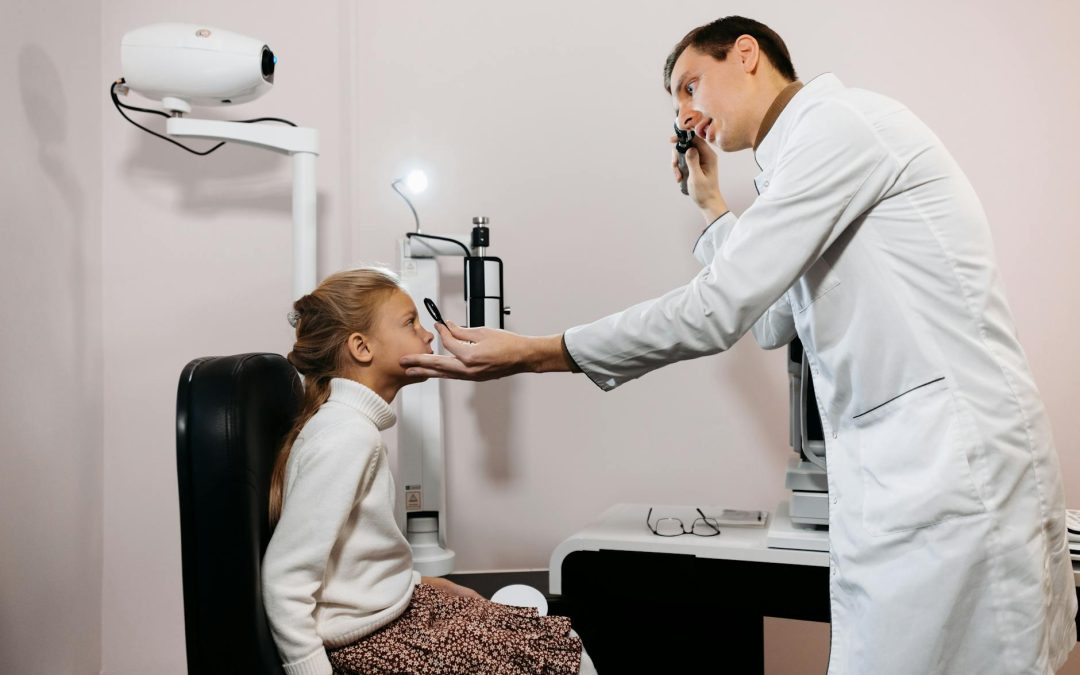
The short version. Orthokeratology — Ortho-K, also known as Corneal Reshaping Therapy (CRT) — uses specially designed rigid contact lenses worn only during sleep. They gently reshape the front of the cornea overnight. You take them out in the morning and see clearly all day without any correction. For myopic adults it is an alternative to LASIK that is fully reversible. For children, it is one of the most-evidence-based myopia control treatments available — slowing the disease while delivering glasses-free daytime vision. We fit Ortho-K at Vision Experts in Amman for both groups. Here is how it actually works.
What Ortho-K is
Ortho-K is a non-surgical procedure that temporarily reshapes the cornea using a specially designed rigid gas-permeable contact lens. The lens is worn during sleep — typically 6–8 hours per night — and gently flattens the central cornea while creating a steeper mid-peripheral ring. By morning the cornea is reshaped enough that light focuses correctly on the retina without any further correction. The patient removes the lenses, and clear vision lasts for the day (and usually well into the next evening).
The reshaping is fully reversible. If you stop wearing the lenses, your cornea returns to its original shape within a few days to a few weeks. There is no surgery, no permanent change, no tissue removed. It is the closest thing in clinical optometry to “Tuesday’s vision in Wednesday’s eye.”
Who Ortho-K is for
The two main groups of Ortho-K patients at our clinic are quite different:
1. Children with progressing myopia
This is the larger group. A 2020 meta-analysis of randomized trials concluded Ortho-K slows axial elongation in myopic children by approximately 40–55% versus single-vision glasses or single-vision soft contacts — comparable to the best eyeglass-based myopia control options (Stellest, MiYOSMART, MyoCare) and to soft myopia-control contact lenses like MiSight.
The advantage of Ortho-K for children is the glasses-free daytime experience. A child who has tried regular myopic glasses and disliked them — for sport, for self-image, for the simple inconvenience of dropped frames — often takes to Ortho-K immediately. The lenses go in at bedtime, come out at breakfast, and the child sees normally through the rest of the day.
Ortho-K is typically considered for children aged 8 and up with myopia between -0.50 and -6.00 D, low astigmatism (under -1.50 D), and parents able to supervise lens handling. We have fit some children as young as 6 in special cases (a very motivated family, low refractive error, a kid who already handles small objects competently).
2. Adults who want glasses-free vision without LASIK
For myopic adults — especially those between 30 and 50 — Ortho-K is an attractive alternative to refractive surgery. There are several reasons one might prefer it:
- Reversibility. If you want to stop, you stop. Your cornea returns to its original shape. LASIK is permanent.
- Suitability range. Some patients are not LASIK candidates — thin corneas, irregular astigmatism, autoimmune conditions, certain professions. Ortho-K fits some of those.
- No surgery risk. No surgical complication is possible because there is no surgery. The risks of Ortho-K are real but smaller and managed by good fit and proper hygiene.
- Future-proofing. Refractive surgery in a young adult who is still progressing can be undone by future myopia growth. Ortho-K adapts as the prescription evolves — we simply re-fit.
- Cost over a long time horizon. Ortho-K is paid annually (lenses are typically replaced once a year, plus solutions and follow-up visits). LASIK is paid once and is done. Whichever is cheaper depends on how long you wear Ortho-K.
How the fitting works
Ortho-K is one of the most technically demanding contact lens fittings. The reshaping effect depends entirely on the lens landing exactly where it should — millimetres off and the cornea reshapes in the wrong place, or not at all. The fitting process at our clinic looks like this:
- Baseline measurement. Refraction, slit-lamp exam, comprehensive corneal topography (TMS-5 Scheimpflug imaging — anterior and posterior elevation), tear film assessment, pupil size in dim light. Some practices fit Ortho-K from refraction alone; we do not. The topography is the lens design input.
- Patient counselling. Ortho-K is a commitment — the lenses must be worn nearly every night to maintain the effect. Missing a night is usually fine; missing several nights means vision deteriorates back toward baseline. A patient who is not committed to nightly wear is not a good Ortho-K candidate.
- Lens selection and ordering. The lens design is calculated from the topography and prescription. For straightforward cases the lens arrives within 1–2 weeks. For complex corneas (post-LASIK regression, high prescription) custom designs can take longer.
- First insertion and overnight trial. The first night is in the lens. We see the patient the next morning, before lens removal and after removal, to measure the reshaping effect and the post-removal vision. Adjustments to centration, sagittal depth or peripheral curve happen here.
- Follow-up at one week, one month, and three months. By month three most patients are fully stable and on a routine — sleep in the lenses, remove on waking, store, repeat. Cleaning protocol, solution choice and replacement schedule are all explicit.
What it feels like
The lens is rigid, but because you are asleep you do not notice it. The first 1–2 nights some patients report mild awareness as they fall asleep — by night 3 or 4 this fades. Insertion takes 30 seconds with a small finger or applicator; removal uses a suction-cup tool that lifts the lens off the cornea. Children typically get the routine down within a week.
The daytime experience is the selling point: you wake up, take the lenses out, blink twice, and you see. No glasses, no daytime contacts, no eye drops. Sports, swimming, makeup, dust, sunlight — all of it works the way it would for a person with naturally good vision.
What can go wrong
Honest list:
- Microbial keratitis. Any contact lens worn overnight carries an elevated risk of corneal infection vs daily-wear. Modern Ortho-K hygiene protocols and high-Dk lens materials have brought the rate down to roughly 1 in 7,700 wear-years, comparable to extended-wear soft contact lenses. We are explicit about cleaning protocols and emergency signs (eye pain that worsens through the day, redness that does not clear, light sensitivity that is new).
- Decentred treatment. If the lens centres off, the reshaping treats the wrong zone of the cornea. The fix is re-fitting, not surgery.
- Glare and halos at night. Some patients with large pupils experience night-time halos because the corneal reshaping creates a sharp boundary between the treated and untreated zones. Modern lens designs minimize this but don’t eliminate it in every case.
- Variable daytime vision. Especially in the first 1–2 weeks, vision can fluctuate through the day as the cornea adjusts. By month 2 most patients have stable all-day vision.
- Cost. Ortho-K is more expensive than glasses or standard contact lenses. The fit is more complex, the lenses are custom, and the follow-up schedule is more intensive.
Ortho-K vs other options for child myopia control
We routinely discuss four myopia control options with families:
- Myopia control glasses (Stellest / MiYOSMART / MyoCare). All-day wear, eyeglass-based. Lowest handling burden. Effective.
- Ortho-K. Nightly wear, daytime freedom. Most freedom-of-vision for the child. Higher handling burden but children adapt quickly.
- Soft myopia-control contact lenses (MiSight). Daytime daily-wear soft contacts with built-in defocus pattern. Easier handling than Ortho-K but daily insertion required.
- Low-dose atropine eye drops (0.01–0.05%). One drop at bedtime in each eye. Pharmacological slowing of axial elongation. Often used in combination with one of the optical methods for stronger effect in fast progressors.
None of these is universally best. The right answer depends on the child’s age, dexterity, lifestyle, prescription, and parental preferences. We map out all four at the first paediatric myopia consultation.
Frequently asked questions
How quickly does Ortho-K work?
Most patients see a meaningful improvement after the first night and reach near-final correction within 5–10 days of consistent overnight wear. Full stabilization takes 3–4 weeks.
How long does the effect last after I stop wearing them?
The cornea returns to its baseline shape within a few days to a few weeks of stopping. The exact rate depends on individual corneal elasticity, but by 2–4 weeks most patients are back to their original prescription.
Is Ortho-K safe for children?
When properly fit and properly cared for, yes. The infection-risk data are well established and comparable to other overnight-wear modalities. The decision is more about parental supervision than safety — for an 8-year-old to be on Ortho-K, a parent needs to supervise insertion and removal and enforce the cleaning routine.
Can adults get Ortho-K too?
Yes. Many of our adult patients are in their 30s and 40s. The myopia-control benefit of Ortho-K matters less for adults (whose myopia has stabilized), but the glasses-free daytime experience matters just as much. For adults considering refractive surgery, Ortho-K is often worth trying first.
Does it work for astigmatism?
For low astigmatism (under -1.50 D), standard Ortho-K designs work well. For higher astigmatism, toric Ortho-K designs are available but the fitting is more demanding and the success rate is lower. Patients with very high astigmatism may be better suited to scleral lenses or other modalities.
What if my prescription changes while I’m wearing them?
We re-fit. Children’s prescriptions in particular may evolve, and a re-fit captures the new shape. Most patients need a lens redesign every 12–24 months — partly for prescription changes, partly because lens material naturally degrades.
Can I swim while wearing Ortho-K?
Not in the lenses. The fluid exchange between pool/sea water and the lens-cornea space is a contamination risk. But the daytime corneal reshaping itself is perfectly compatible with swimming — you can swim during the day without any correction.
Will I see well immediately after taking them out?
Yes, after the first 5–10 days of treatment. The first 2–3 mornings of wear, vision may be slightly hazy on removal until the cornea has been progressively reshaped. By the end of the first week, most patients have clear vision all day after lens removal.
What to do next
Ortho-K is not for everyone — but for the right patient, it is genuinely transformative. If you or your child are considering it, the right first step is a comprehensive eye exam plus corneal topography. The topography determines whether Ortho-K is feasible and what the lens design would look like. The whole consultation is approximately 60 minutes.
You can book an appointment online, email info@visionexperts.net, or call +962 6 566 6122 or WhatsApp +962 77 566 6122. Our corneal reshaping (Ortho-K) service page has the operational details. If you would like to read about other paediatric myopia control options before your visit, our myopia control page covers the full set.
Bilal Rawashdeh is the founder and lead clinician at Vision Experts in Amman, Jordan. He has fit Ortho-K (CRT) lenses for two decades in both paediatric and adult patients. This article is for general information and does not substitute for an in-person clinical assessment.